
Most parents enrolling a child in piano are told two things, start early and practise daily. Both are broadly true and neither is much help when you are standing in front of four schools with similar websites and similar fees. The decisions that determine whether a child is still playing at fourteen are made at enrolment, and they are mostly about fit. Choosing a piano class for kids singapore parents will be happy with a year later starts with understanding what happens in the room.
Readiness Matters More Than Age
The common answer is that children can begin around five or six, but readiness is not a birthday. A child who can sit and attend for fifteen minutes, follow a two-step instruction, and reach the keys with their forearms roughly level is ready. One who cannot yet do those things will spend lessons frustrated regardless of ability. Some four-year-olds are ready; some seven-year-olds are not. A teacher who assesses readiness rather than quoting an age is a good sign.
What Good Early Teaching Looks Like
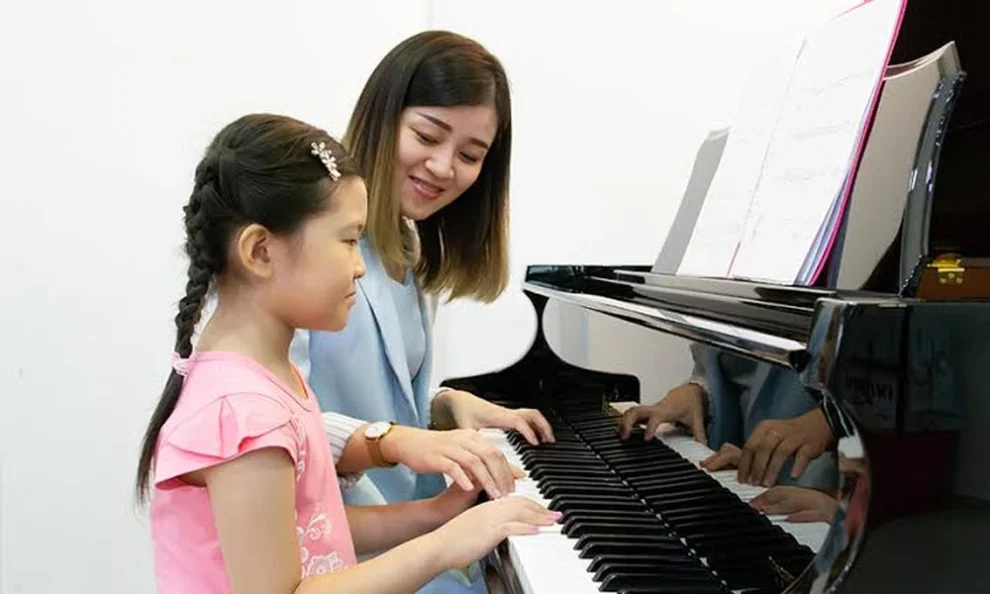
The first year should build a small number of things properly, a relaxed curved hand, a sense of steady pulse, recognition of note names and rhythmic values, and the habit of listening to what has just been played. Well-run beginner lessons move between short activities because a six-year-old’s attention does not survive thirty minutes of the same task. Rhythm games, clapping, singing and short pieces alternate. If a trial lesson consists of a child sitting silently working through a book, that is worth noticing.
Group or Individual
Group classes suit young beginners well. Children learn rhythm and listening faster alongside peers, the atmosphere is less pressured, and the cost is lower. Individual lessons become more valuable once technique gets specific, because posture and finger issues need one-to-one correction. Many families start in a group and move to private lessons after a year or two. Ask what the school’s usual pathway is, and whether class sizes are small enough that each child gets to play in every session.
The Instrument at Home
A child cannot progress on a toy keyboard. The minimum practical setup is a digital piano with eighty-eight weighted keys and a sustain pedal, which develops the finger strength and touch control an unweighted keyboard cannot. Acoustic pianos are better still if you have the space and are prepared to tune them once or twice a year. Place the instrument where the family is, not in a spare room. Practice that happens in the middle of household life happens far more often than practice exiled upstairs.
Practice: Short, Daily, Supervised
Ten to fifteen minutes a day for a beginner is more effective than an hour at the weekend, and the daily habit is the thing being built. Young children need a parent nearby, not to teach but to keep the session on task and to notice which two bars the teacher marked. Ask the teacher for a specific weekly assignment rather than a general instruction to practise. A child who knows exactly what to do will do it; one who sits down to “practise the piano” will play their favourite bit and stop.
Reading Music and Playing by Ear Are Different Skills
A child can be fluent at one and helpless at the other, and both are worth having. Reading opens up any piece ever written down and is essential for ensemble playing later. Playing by ear lets a child work out a tune they like, transpose it, and eventually improvise, which is usually what keeps teenagers at the instrument once the novelty fades. Ask how a school develops each. Programmes that teach only notation tend to produce students who cannot play anything without the page in front of them, and that dependence is difficult to unlearn.
Examinations Are a Tool, Not a Goal
Graded examinations give structure, a deadline and a measurable outcome, and many children respond well to that. They also narrow repertoire to three pieces for months at a time and can turn a hobby into an obligation. Some children thrive on the target; others lose interest entirely. Discuss the option with the teacher rather than assuming exams are automatic, and be willing to skip a grade year if enjoyment is dropping. A good piano lesson for children programme can accommodate both approaches.
Practical Fit With Family Life
Consider travel time, the slot in the week, and whether the lesson lands after a long school day when a child has nothing left. Ask about make-up lessons for illness, term structure, and whether the same teacher stays with your child or rotates. Consistency of teacher matters a great deal for young students, who take time to trust an adult enough to make mistakes in front of them.
Signs It Is Working
After a term, look for three things, the child can name what they are working on, they occasionally play something without being asked, and they are not dreading the lesson. Technical progress at this age is uneven and comparison with other children is unhelpful. What predicts long-term playing is enjoyment plus a habit. When a piano class for kids singapore families choose delivers both, the grades and the technique tend to follow on their own.